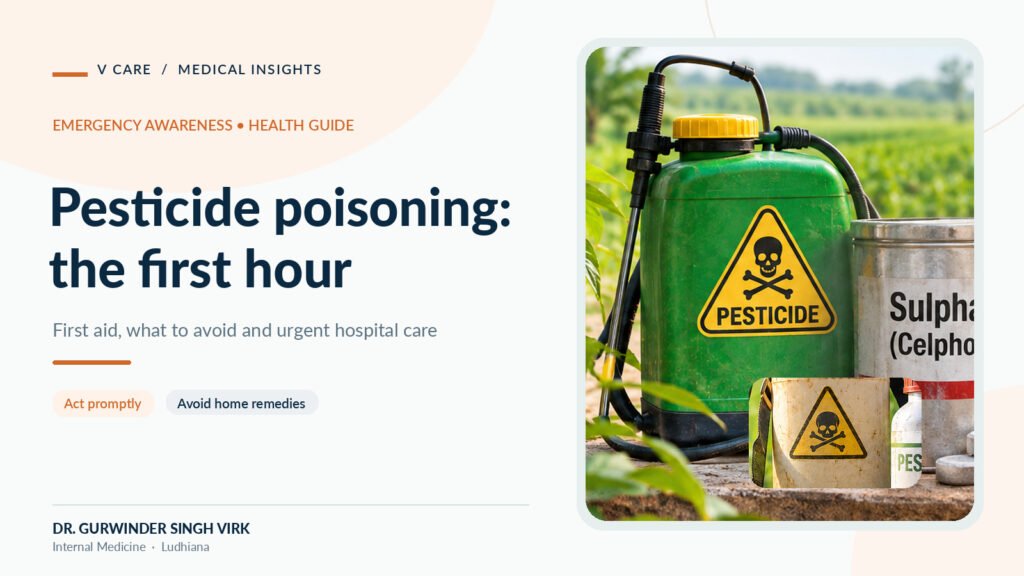
Pesticide Poisoning: What to Do in the First Hour
Farm chemicals are part of everyday life for many families. Crop sprays, and the grain storage tablets often called sulphas, sit in sheds, courtyards and sometimes right next to the kitchen.
When one of them is swallowed, breathed in or soaked into the skin, the first hour matters a great deal. Here is what to do, what not to do, and what happens once the patient reaches hospital.
The chemicals behind most cases
- Organophosphate and carbamate insecticides. These are the common crop sprays. They overwork the nerves that control muscles, glands and breathing.
- Aluminium phosphide (sulphas, celphos). Used to protect stored grain. Inside the body it releases phosphine gas, which damages the heart and blood vessels. It is one of the deadliest poisons seen in Indian hospitals, and there is no antidote.
- Weedkillers such as paraquat. Even a mouthful can be fatal, and lung damage can show up days later. There is no antidote for this either.
Signs of organophosphate poisoning
Symptoms can start within minutes or over a few hours:
- Heavy sweating, drooling and watery eyes
- Very small, pinpoint pupils
- Vomiting, loose motions, passing urine without control
- Muscle twitching, then weakness
- Chest tightness, wheeze, frothy secretions and difficulty breathing
- Slow pulse, drowsiness, fits
- A strong chemical or kerosene-like smell on the body or breath
With sulphas, look for repeated vomiting, a burning pain in the stomach, a smell like garlic or rotten fish, cold and sweaty skin and a fast fall in blood pressure. Some patients look surprisingly well for the first hour and then collapse, so do not let an early calm fool you.
First hour: what to do
- Arrange transport to a hospital with emergency and ICU care. Call 108 for an ambulance or 112. Do not spend time on home remedies.
- Protect yourself. Wear gloves, or plastic bags over your hands. Organophosphates pass through skin, and helpers can be poisoned too.
- If it is on the skin or clothes, take the clothes off and wash the skin and hair with soap and plenty of water.
- If it is in the eyes, rinse them with clean running water for 15 minutes.
- If it was breathed in, move the person into fresh air.
- If the person is drowsy or unconscious, lay them on their side so vomit does not go into the lungs.
- Bring the container, packet or label, or a clear photo of it. Knowing the exact chemical changes the treatment.
- Note the time and roughly how much was taken.
What not to do
- Do not make the person vomit. It can push poison into the lungs.
- Do not give milk, ghee, oil, salt water or any home antidote. None of them neutralise pesticides, and they waste time.
- Do not give anything by mouth unless a doctor tells you to.
- With sulphas, keep the room or vehicle well ventilated. Vomit can give off phosphine gas, so avoid leaning over it and breathing it in.
What happens in hospital
For organophosphate poisoning, the team cleans off any remaining chemical, gives oxygen and starts atropine. The dose is increased until the chest is clear of secretions, the pulse is steady and the blood pressure holds. Some patients also receive a drug called an oxime. If the breathing muscles weaken, the patient goes on a ventilator in the ICU.
Families are often surprised when a patient who seemed better on day two is still kept in hospital. There is a reason. Between 24 and 96 hours after poisoning, some people develop the intermediate syndrome: weakness of the neck, shoulders, hips and breathing muscles. It can come on quietly and may need ventilator support, so close watching continues even after the first crisis has passed.
For sulphas, treatment is intensive supportive care: fluids, medicines to hold up blood pressure, heart monitoring and treatment of the body’s acid levels. How quickly the patient reaches an ICU is one of the biggest factors in survival.
Keeping families safe
- Store pesticides and sulphas tablets in a locked box, away from the kitchen and well out of children’s reach.
- Never pour chemicals into cold drink or water bottles. Many accidental poisonings start this way.
- When spraying, wear full sleeves, gloves and a mask, keep the wind at your back, and do not eat, drink or smoke until you have washed.
- Wash and change clothes straight after spraying, and wash them separately.
- Keep fumigation of grain to a sealed store, away from rooms where people sleep.
If it was not an accident
Some poisonings are not accidents. If someone you know has taken poison on purpose, or has talked about ending their life, they need emergency treatment first and support after that. India’s national mental health helpline, Tele MANAS, is free and open 24 hours on 14416 or 1-800-891-4416.
Common questions
Can someone recover fully from pesticide poisoning? Many people do, especially when they reach hospital early. The outcome depends on the chemical, the amount and how quickly treatment starts.
Should I give milk to someone who swallowed poison? No. Milk does not neutralise pesticides, and the time spent on it delays treatment. Get the person to hospital instead.
When to see a doctor
Any suspected pesticide poisoning is an emergency, even if the person seems fine. Dr. Gurwinder Singh Virk treats poisoning cases in Ludhiana, with critical care and ventilator support for severe cases. For follow-up after discharge, you can book a consultation here.
This article is for general information and does not replace emergency care or a consultation with your doctor.