Smog Season in Ludhiana: Who Is at Risk and When to See a Doctor
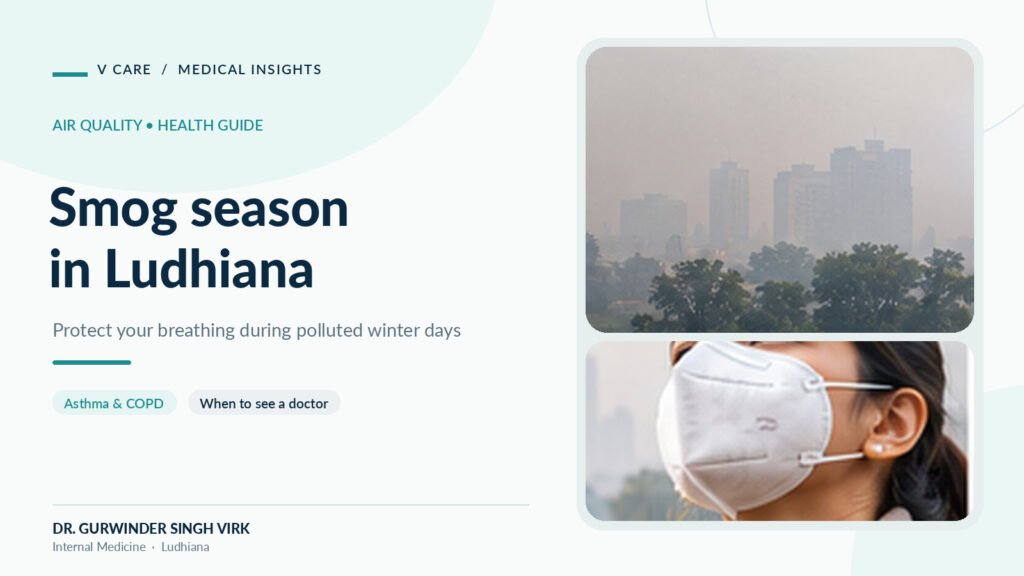
From late October, the air over Ludhiana changes. Smoke, dust, traffic fumes and Diwali fireworks build up in the air. Then the cold, still air of early winter holds all of it close to the ground.
For a healthy adult it means itchy eyes, a scratchy throat and a cough that will not settle. For someone with weak lungs or a weak heart, it can mean a hospital visit.
What is actually in the air
The part that does the most harm is PM2.5: particles so fine that they slip past the nose and throat, settle deep in the lungs and even pass into the bloodstream.
On bad air days, doctors see more asthma attacks, more COPD flare-ups and more chest infections. Polluted air also raises the risk of heart attack and stroke, which is why it is not only a lung problem.
Who needs to be most careful
- People with asthma or COPD. COPD is common in older smokers, and in women who cooked over a chulha or angithi for many years.
- People with heart disease
- Older adults and young children
- Pregnant women
- People with diabetes
- Anyone recovering from pneumonia or TB
What actually helps
Check the air before you step out. The Central Pollution Control Board’s Sameer app shows the live AQI for Ludhiana. On “poor” or worse days, cut down time outdoors, especially exercise.
Wear the right mask. A well-fitted N95 or N99 mask filters fine particles. Cloth and loose surgical masks do very little against PM2.5. N95 masks are not made to fit small children properly.
Rethink the morning walk. In winter, smog is often thickest at dawn and late in the evening. On bad days, walk indoors or go later in the morning once the sun is out.
Keep the indoor air cleaner.
- Keep windows shut during the worst hours.
- No smoking inside the house, by anyone.
- Avoid agarbatti, dhoop and mosquito coils in closed rooms.
- Use the kitchen exhaust when cooking.
- An air purifier with a HEPA filter helps in a closed bedroom, if it is sized for the room.
Stay on top of your medicines. If you have asthma or COPD, take your preventer inhaler every day as prescribed, not only the blue reliever when things get bad. Ask your doctor to check your inhaler technique. Inhaler mistakes are very common, and with poor technique much of the medicine never reaches the lungs. Keep a spare reliever at home.
Get vaccinated. An annual flu shot is advised for older adults and anyone with lung, heart or kidney disease or diabetes. A pneumococcal vaccine is recommended for older adults and for younger people with these conditions. Ask your doctor which ones you need.
Do not add to it. Burning leaves or garbage, even in small piles, adds to the smoke your own family breathes.
See a doctor the same day if
- You need your reliever inhaler more often than usual, or it no longer lasts 4 hours
- Wheeze or chest tightness wakes you at night
- A cough comes with fever, yellow or green phlegm, or chest pain on breathing in
- Your feet are swelling and you get breathless lying flat
Go to emergency straight away if
- You are breathless at rest or cannot finish a sentence
- Lips or fingertips look bluish
- The person is confused or unusually drowsy
- A home pulse oximeter reads 92% or lower, or below the target your doctor gave you if you have COPD
- There is chest pain
Common questions
Do air purifiers really work? In a closed room, a HEPA purifier of the right size does lower indoor PM2.5. It does little if the doors and windows stay open.
Should I stop my morning walk completely? No. Keep moving, but on bad air days walk indoors, on a terrace later in the day, or in a mall or covered space.
Does steam inhalation clear pollution from the lungs? No. Steam can ease a blocked nose for a while, but it does not remove particles from the lungs.
When to see a doctor
If your breathing has been worse since the smog arrived, or a cough has lasted more than two weeks, get it checked rather than waiting for the air to clear. Dr. Gurwinder Singh Virk, Senior Consultant in Internal Medicine in Ludhiana, treats asthma, COPD and chest infections, with critical care and oxygen support when breathing becomes severe. You can book a consultation here.
This article is for general information and does not replace a consultation with your doctor.